Wireless · DSP · Machine learning
Wi-Fi CSI Indoor Localization
GPS stops at the door. The version of this that went around last summer used one ESP32 and a router, so one link, and I wanted to know what a small network would do instead. Three nodes give nine directed links, and locate a person from nothing but the way their body disturbs the Wi-Fi packets crossing between them. No tag, no camera, nothing carried by the person being tracked.
Why three nodes
- One link cannot triangulate. It says the channel changed, not where. Nine links from three directions turn that into a position.
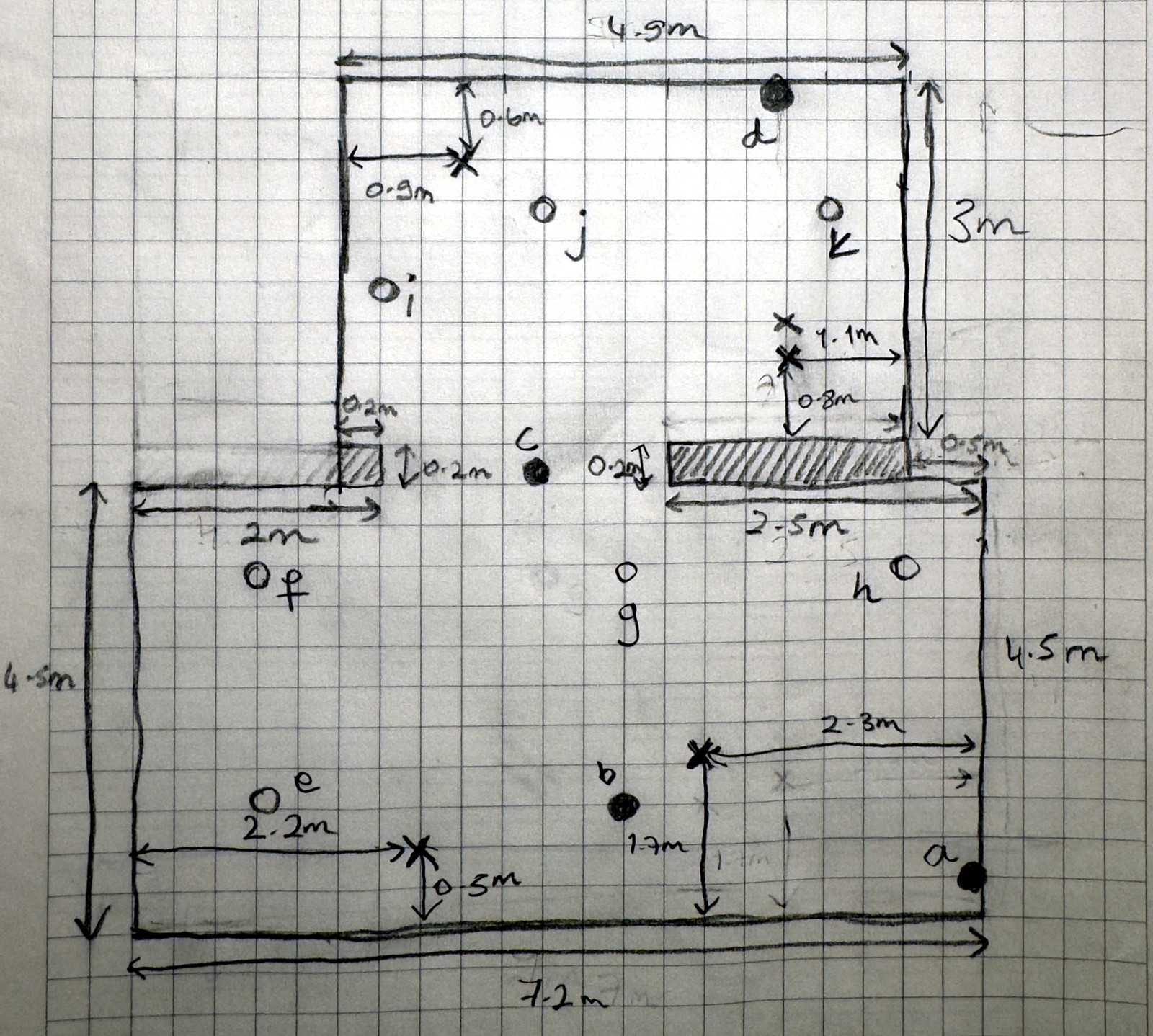
- The nodes see different rooms. Two below the dividing wall, one above. A single node in one room is blind to the other.
- A dead link stops being fatal. One of the nine is wall-blocked and contributes almost nothing. With one link that would be the whole system.
1 - 10
- 1a → b
- 2a → h
- 3b → a
- 4b → g
- 5b → e
- 6e → b
- 7e → f
- 8h → a
- 9h → g
- 10g → h
11 - 20
- 11g → b
- 12g → f
- 13g → c
- 14f → e
- 15f → g
- 16c → i
- 17c → j
- 18c → k
- 19c → d
- 20c → g
21 - 30
- 21i → j
- 22i → c
- 23j → i
- 24j → c
- 25j → k
- 26j → d
- 27k → c
- 28k → j
- 29k → d
- 30d → c
31 - 40
- 31d → k
- 32d → j
- 33i → x
- 34c → x
- 35d → x
- 36j → x
- 37x → d
- 38x → f
- 39x → c
- 40x → j
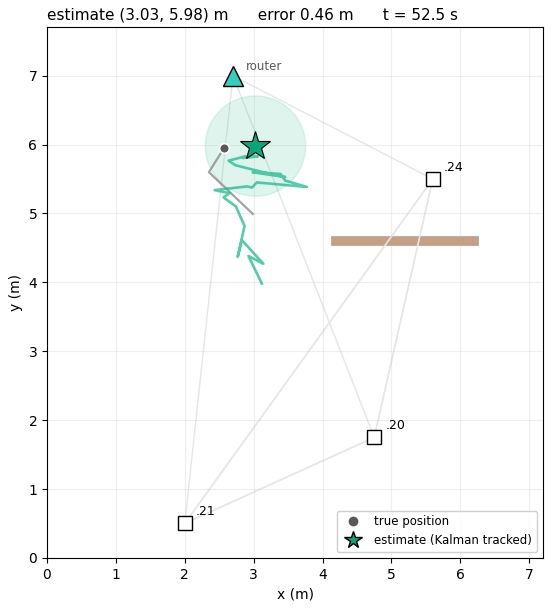
ESP32 node .21 | (2.2, 0.5) · lower room, left |
|---|---|
ESP32 node .20 | (4.9, 1.7) · lower room, right |
ESP32 node .24 | (5.6, 5.5) · upper room, doubles as waypoint x |
| Router | (2.7, 7.1) · upper room, far corner |
| Doorway between halves | 1.4 m opening, waypoint c at (3.4, 4.6) |
Held out by location, not at random. CSI samples a fraction of a second apart are nearly identical, so a random split leaves almost every test sample with a near-duplicate in training and the reported error collapses to something impressive and meaningless.
| Median localization error | 0.79 m · recorded CSI |
|---|---|
| 90th percentile | 1.78 m |
| Evaluation protocol | Leave-location-out cross-validation, 178 locations |
| Nodes and links | 3 × ESP32, 9 directed links at 50 Hz |
| Link layer | ESP-NOW beacons streamed over UDP, connectionless so the rate holds |
| Routes | 40 directed routes over 12 waypoints |
| Training data | 40 routes × 3 sessions at 3 average walking speeds |
| Models | RandomForest + CNN, constant-velocity Kalman tracking |